Browse All Resources
Grief and Loss
Whatever loss you’ve suffered, there’s no right or wrong way to grieve. Find free tools for managing grief-related stresses, a daily email subscription, and more.

45 Resources Found

caregiving.com
Death Cafes: Normalizing conversations about death, dying & loss
This Caregiving.com article introduces Death Cafes — informal gatherings where people come together, often over tea and cake, to talk openly about death, dying, and loss. It explains a movement dedicated to breaking the silence around mortality, a silence that often leaves families unprepared and isolated when death approaches.The article describes what a Death Cafe is and isn't: not grief counseling or a support group with an agenda, but a relaxed, confidential space where participants can discuss death honestly, ask questions, and share perspectives without judgment. The goal is simply to normalize a topic our culture tends to avoid, helping people become more comfortable thinking and talking about end-of-life matters. For caregivers and families, this comfort can translate into better conversations, clearer planning, and less fear when facing a loved one's decline or death.This resource matters because avoidance of death talk leaves families scrambling at the worst possible moments — unsure of wishes, afraid to broach the subject, and alone in their grief. Death Cafes and the broader movement they represent offer a gentle on-ramp to these essential conversations. For caregivers navigating end-of-life realities, learning about Death Cafes can open the door to more openness and preparedness. The article is freely available on Caregiving.com.
caregiving.com
How to Respond When Your Loved One Says, “I’m Dying”
Here are some suggestions of what to say and do to support someone who's nearing the end of their life.

caregiving.com
Why Humor is so Critical During End-of-Life Care
Though it may seem ill-fitting, bringing humor into the end-of-life experience can offer relief and help families and friends create new, cherished memories.
caregiving.com
Essential Questions to Ask Someone You Love Before They Die
A death doula shares eight questions that can bring joy, clarity, and healing to an end-of-life experience.

caregiving.com
Michael Hebb
Learn how childhood experiences as a caregiver and patient influenced Michael's work.

caregiving.com
A New Beginning for End-of-Life Doulas
Doulas offer holistic care and support to the dying and their loved ones.

caregiving.com
Alternative Options for Laying a Loved One to Rest
Understand your burial options to choose what's right for you.

caregiving.com
Creating (and Updating) a Last Will and Testament
Here's what you need to know on how to create and update a will.

caregiving.com
A Mother’s Love
A former caregiver fondly recalls his mother's morning routine.

caregiving.com
Breaking Down Myths and Stigmas of Grief
Read how to combat these emotions and their effects on us.

caregiving.com
Phases of the Grief Journey and How a Grief Coach Can Help
Find out how a grief coach can help you navigate grief.

caregiving.com
Be on the Lookout for Scams Related to Death
When obituaries are published in newspapers, on websites, and in social media (so easy to get the word out to everyone now), be aware that this information can spoon feed scammers the precise nuggets they need to reach out to you in your time of emotional insecurity.

caregiving.com
Selling the Family Home
When your parents are ready to leave the family home, your work begins...

caregiving.com
Turning off Services
Before I attempt to start listing all the different companies you need to contact to turn off services that are billed for the home, let me just say...

caregiving.com
When Your Person Passes Away: Your To Do List
Being prepared in advance so that this shutting down process is not overwhelming is the best way to get through this rough time. A binder or folder or envelope with everything you will need already prepared will make things less overwhelming when you are not likely to be in a clear-headed and focuse...

caregiving.com
Unanticipated Aspects of Grief
Grief is a profound journey that unfolds uniquely for each individual. While many are familiar with the stages of grief there are intricate facets of the grieving process that often catch people off guard

caregiving.com
Finding Harmony in Belongings: Methods for Sorting a Loved One's Estate
Finding a structured approach to navigate the process of sorting through a deceased loved one's belongings while grieving is no easy feat.

caregiving.com
Open Communication During the End-of-Life Journey - Connecting with Friends and Family
In the midst of preparing for the passing of a loved one, open and compassionate communication with their loved ones and family members becomes an essential pillar of support

caregiving.com
Understanding the Role of End-of-Life Doulas
During the end of life journey, much has to be done while coping with powerful emotions. To ease the process, End of Life Doulas or Death Doulas are...

caregiving.com
Preemptive Grief: Embracing the Present with Your Loved One
As the prospect of a loved one's passing becomes a reality, preemptive grief can cast a shadow over even the most precious moments. Striking a...

caregiving.com
Nurturing Your Wellbeing - Balancing Being Present and Self-Care
As you navigate the emotional journey of preparing for a loved one's passing, remember that your own wellbeing matters too.
caregiving.com
End of Life Conversations - What to Ask Your Loved One
Engaging in open and thoughtful conversations during this time can provide comfort, closure, and ensure that your loved one's wishes are communicated and honored

caregiving.com
End of Life Conversations - Self-Reflection
Grieving the loss of a loved one is a deeply personal journey that involves a range of emotions, memories, and reflections. As you navigate this challenging time, self-reflection can play a vital role in understanding your feelings, finding meaning, and honoring the memory of the person you love

caregiving.com
End of Life Conversations - Starting the Conversation
Broaching the topic of end-of-life wishes with a loved one is a tender and profound endeavor, requiring compassion, patience, and a deep understanding of emotions.

caregiving.com
Embracing Healing Amidst Profound Loss - The Journey of Losing a Child
Losing a child due to medical needs is a journey that transcends words—a path marked by profound emotions, tender memories, and a complex blend of grief
caregiving.com
The Grief of a Changing Relationship
Morning the relationship you had and the dreams for the future is entirely natural, NOT a sign of weakness or neglect. It's a testament to the depth of your love and the profound impact this abrupt turn in your journey has on your life.

caregiving.com
Treasuring Memories and Mementos: All the Things and the Conflict they may Bring
The journey of saying goodbye to a loved one at the end of their life is charged and marked by profound moments and deep connections. Yet, amidst the...

caregiving.com
Understanding a Loved One's End-of-Life Wishes: A Guide to Honoring Their Legacy
When a loved one approaches the end of their life's journey, ensuring their wishes, values, and preferences are respected may start to weigh on you

caregiving.com
Anticipatory Grief: The Emotional Journey of Terminal Diagnoses
When a loved one receives a terminal diagnosis, what follows is often marked by an under-discussed but deeply impactful aspect of grief: anticipatory...

caregiving.com
Embracing the Present with Your Loved One
As the prospect of a loved one's passing becomes a reality, preemptive grief can cast a shadow over even the most precious moments

caregiving.com
Capturing Fading Memories
As life takes its course, the memories and stories of our aging loved ones become increasingly precious. The tales of their joys, challenges, triumphs, and lessons learned hold immense value
caregiving.com
Hospice Care: Finding the Right Fit
Let’s demystify hospice care services, both at home and in facilities, and give you some essential questions to steer you in your decision-making journey.

caregiving.com
Death, Dying, Loss, And Grief: Talking with Children And Youths
Death, dying, loss, and grief are topics that carry taboos, confusion, mystery, fear, worry, or pain, to the point where most of us don’t know how to talk about how it affects us, including children and youth.

caregiving.com
Episode 3: Life after caregiving
“Life After Caregiving” is Episode 3 of Caregiving.com's Champions Corner — a podcast/video series featuring real conversations with real caregivers. This episode focuses on a transition that receives far too little attention: what happens after caregiving ends, whether through a loved one's death, a move to a facility, or recovery.The episode explores the complex experience of life after the caregiving role concludes: the grief not only for the loved one but for the role and identity that consumed so much time and energy; the disorientation of suddenly having time and freedom that feel empty; the challenge of rebuilding a life, relationships, and sense of self; and the mix of relief, guilt, loss, and uncertainty that follows. By sharing honest, lived experiences, Champions Corner offers former caregivers recognition and the comfort of hearing others describe what they're going through.This resource matters because the end of caregiving is a profound, under-supported transition — former caregivers often feel adrift and alone, with their grief compounded by the loss of purpose and routine, yet little guidance exists for this stage. Honest peer conversation validates the experience and offers hope for rebuilding. For caregivers approaching or living through life after caregiving, this episode provides companionship and insight. It is freely available on Caregiving.com.
caregiving.com
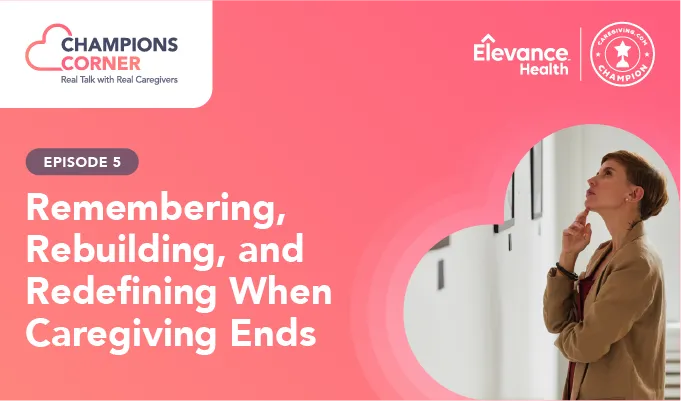
Episode 5: Remembering, Rebuilding, and Redefining When Caregiving Ends
“Remembering, Rebuilding, and Redefining When Caregiving Ends” is Episode 5 of Caregiving.com's Champions Corner, a series of real conversations with real caregivers. This episode digs into the work of moving forward after the caregiving role concludes — honoring the past while building a new chapter.The episode's three themes capture the journey former caregivers face: remembering — honoring the loved one and the caregiving experience, and integrating it rather than erasing it; rebuilding — reconstructing a daily life, relationships, and routines that caregiving had displaced; and redefining — rediscovering or reshaping one's identity and purpose beyond the caregiver role. Through candid conversation, it acknowledges the grief and difficulty of this transition while pointing toward growth and renewal. Hearing others articulate this process offers former caregivers both validation and a sense of possibility.This resource matters because what comes after caregiving is a real and often painful passage that receives little attention or support — former caregivers can feel lost, grieving both a person and a purpose. Honest peer perspectives on remembering, rebuilding, and redefining provide a roadmap and reassurance that a meaningful life after caregiving is possible. For caregivers navigating the end of their role, this episode offers companionship and hope. It is freely available on Caregiving.com.

caregiving.com
Grief is Not Linear
“Grief is Not Linear” is a Caregiving.com article that corrects one of the most persistent and harmful misconceptions about grief: the idea that it moves in orderly, predictable stages toward a tidy resolution. In reality, grief loops, surges, recedes, and resurfaces unpredictably — and understanding this is freeing.The article explains that the familiar "stages of grief" were never meant to be a rigid, sequential roadmap, and that real grief is messy and individual. A person may feel acceptance one day and be flooded with raw sorrow the next; grief can quiet for months and then return with full force at an anniversary, a song, or a random moment. The article validates this nonlinear reality, reassuring the bereaved that there's no "behind" or "ahead," no failing to "progress" — only their own authentic journey. It helps people release the pressure to grieve "correctly" or on a schedule.This resource matters because the linear-stages myth causes real harm: grieving people judge themselves for not "moving on," feel something is wrong when grief returns, and may hide their ongoing pain. Understanding that grief isn't linear removes that self-judgment and lets people grieve in their own way and time. For caregivers coping with loss, this article offers clarifying, compassionate truth. It is freely available on Caregiving.com.

caregiving.com
Three Steps to Living Your Life After Caregiving
This Caregiving.com article offers a practical, three-step framework for rebuilding life after the caregiving role ends. For former caregivers who feel adrift once their responsibilities conclude, it provides structure and direction at a disorienting time.The article recognizes that life after caregiving brings a unique mix of grief, relief, lost identity, and uncertainty — and that simply being told to "move on" is unhelpful. Instead, it breaks the process into three actionable steps that guide former caregivers from loss toward renewal: typically involving honoring and processing the experience and grief, reconnecting with oneself and rebuilding routines and relationships, and redefining purpose and looking forward to a new chapter. By making the path concrete, it helps former caregivers take real steps rather than remaining stuck in the void left by caregiving's end.This resource matters because the end of caregiving is a major life transition that often catches people unprepared — their days suddenly empty, their identity unclear, their grief layered with the loss of purpose. A clear, step-by-step approach gives former caregivers a sense of agency and hope, helping them move toward a meaningful life beyond caregiving. For anyone facing or living through this transition, the article offers actionable guidance. It is freely available on Caregiving.com.

caregiving.com
Awaiting Loss: The Silent Struggle of Anticipatory Grief
“Awaiting Loss: The Silent Struggle of Anticipatory Grief” is a Caregiving.com article that gives voice to a largely invisible experience: the grief that builds while waiting for a loss that hasn't yet come. It names anticipatory grief as a real and silent struggle that many caregivers endure without recognition or support.The article explores what it's like to live in the prolonged shadow of an expected loss — caring for a loved one with a terminal or progressive illness while grieving them before they're gone. It describes the loneliness of this experience (others may not understand grieving someone still alive), the emotional toll of sustained anticipatory grief, and the guilt that can accompany it. It validates these feelings as normal and offers comfort and coping strategies, helping caregivers carry this silent burden with more understanding and less self-judgment.This resource matters because anticipatory grief is widespread among caregivers yet so rarely discussed that those experiencing it often feel they're alone or grieving "wrong." Naming the "silent struggle" and validating it provides profound relief and connection. It also helps caregivers recognize their need for support during this drawn-out, exhausting period. For caregivers awaiting a loved one's loss, this article offers recognition and companionship in a lonely experience. It is freely available on Caregiving.com.

caregiving.com
Advance Care Planning: What is It?
“Advance Care Planning: What is It?” is a Caregiving.com article that explains a foundational concept every caregiver should understand: the process of planning ahead for future medical care in case a person becomes unable to make or communicate their own decisions. It demystifies a term that's often used but not always understood.The article defines advance care planning and walks through what it involves: reflecting on one's values and wishes for medical treatment, choosing a trusted person to make decisions on one's behalf (a healthcare proxy or patient advocate), documenting those wishes in advance directives such as a living will and durable power of attorney for healthcare, and communicating them to family and clinicians. It emphasizes that advance care planning is an ongoing process, not a one-time form, and that it applies to everyone — not just the seriously ill or elderly.This resource matters because without advance care planning, families and doctors can be left making agonizing decisions without knowing what a loved one would have wanted, leading to stress, conflict, and outcomes that may not reflect the person's wishes. Understanding what advance care planning is — the first step toward doing it — empowers caregivers to ensure their own and their loved ones' wishes are known and honored. For caregivers, this clear introduction is an essential starting point. It is freely available on Caregiving.com.

caregiving.com
What Is Compassion
Compassion at the end of life is witnessing someone else's suffering, resonating with the suffering of another, having the desire to alleviate their suffering.

caregiving.com
Creating and Casting Vision to Live Beyond Caregiving
This Caregiving.com article encourages caregivers and former caregivers to create and "cast" a vision for life beyond caregiving — to imagine and intentionally move toward a future that isn't defined solely by the caregiving role. It addresses the forward-looking work of reclaiming a life.The article speaks to caregivers who have lost sight of their own dreams, goals, and identity amid years of caregiving, and to former caregivers facing an open but daunting future. It guides them to envision what they want their life to look like — their interests, relationships, purpose, and goals — and to take steps toward that vision rather than remaining stuck in loss or aimlessness. "Casting" the vision means making it concrete and committing to it, turning a vague hope into a direction. The article frames this as both healing and empowering: a way to honor the caregiving chapter while consciously building the next one.This resource matters because caregiving can subsume a person's identity and dreams so completely that, when it changes or ends, they don't know who they are or what they want — leaving them adrift. Deliberately creating a vision for life beyond caregiving restores agency, hope, and purpose. For caregivers in transition or looking ahead, this article offers an inspiring, practical framework for moving forward. It is freely available on Caregiving.com.

caregiving.com
Diving Deep Into Anticipatory Grief
A reflection on the experience of anticipatory grief

Grief
While everyone’s experience of grief is different, there are common responses that can be useful to recognize if you’re facing a loss. Whether grieving or supporting a loved one, practice patience as you work through this difficult time.

Coping with Grief and Loss
Whatever loss you’ve suffered, there’s no right or wrong way to grieve. But by understanding the types and stages of grief, you can find healthier ways to cope.

Find a GriefShare group
Find free tools for managing grief-related stresses, a daily email subscription, and more.